• Welcome to the FREE TUGBBS forums! The absolute best place for owners to get help and advice about their timeshares for more than 32 years!

    Join Tens of Thousands of other owners just like you here to get any and all Timeshare questions answered 24 hours a day!
  • TUG started 32 years ago in October 1993 as a group of regular Timeshare owners just like you!

    Read about our 32nd anniversary: Happy 32nd Birthday TUG!
  • TUG has a YouTube Channel to produce weekly short informative videos on popular Timeshare topics!

    All subscribers auto-entered to win all free TUG membership giveaways!

    Visit TUG on Youtube!
  • TUG has now saved timeshare owners more than $24,000,000 dollars just by finding us in time to rescind a new Timeshare purchase! A truly incredible milestone!

    Read more here: TUG saves owners more than $24 Million dollars
  • Wish you could meet up with other TUG members? Well look no further as this annual event has been going on for years in Orlando! How to Attend the TUG January Get-Together!
  • Now through the end of the year you can join or renew your TUG membership at the lowest price ever offered! Learn More!
  • Sign up to get the TUG Newsletter for free!

    Tens of thousands of subscribing owners! A weekly recap of the best Timeshare resort reviews and the most popular topics discussed by owners!
  • Our official "end my sales presentation early" T-shirts are available again! Also come with the option for a free membership extension with purchase to offset the cost!

    All T-shirt options here!
  • A few of the most common links here on the forums for newbies and guests!

New scientific paper: offshore wind turbines alter marine eco-system, could shift ocean currents

Breakthroughs Electronic controls on Solar panels is starting to change the cost of putting solar panels to work in residential locations

The third state has evaluated the safety of plugging the panels into the household circuit
The third state has approved these devices as safe
Just plug them into an existing electrical outlet in the house
Electricity produced by the solar panel flows into the home electrical wires and displaces electricity coming in through the utilities electrical meter

No need for extensive rewiring and ancillary equipment to feed electricity from solar panels into the household grid
Obviously, these are for very small installations, but it is very interesting. Thanks!

Kurt
 
Breakthroughs Electronic controls on Solar panels is starting to change the cost of putting solar panels to work in residential locations

The third state has evaluated the safety of plugging the panels into the household circuit
The third state has approved these devices as safe
Just plug them into an existing electrical outlet in the house
Electricity produced by the solar panel flows into the home electrical wires and displaces electricity coming in through the utilities electrical meter

No need for extensive rewiring and ancillary equipment to feed electricity from solar panels into the household grid

From cleantechnical.com

One of my prime sources for factual information on EVs and modern electrical production


Off the get go it looks like more of your green washing to me.

The plug in solar panel could produce maybe 5000 kwh's over a year worth about $700 where we live. I think the problem is how much these plug in panels cost regarding roi , reliability and warranty. These things cost between $2500 and $3000 so break even is between maybe 4 - 5 years depending on your electricity cost. I doubt I would buy one.

Bill
 
Obviously, these are for very small installations, but it is very interesting. Thanks!

Kurt

The current standard for plug in Solar Systems has been established by Underwriters Laboratories as UL3700

UL3700 sets the current limit at 1.2kwh output

Using an extrapolation from European pricing for a system of this size

These are the best estimates for a 1.2 kW US system

Realistically, when these systems hit the US market later in 2026, you'd expect pricing in the $900–$1,800 range — with early adopter pricing at the higher end, and competition eventually pushing it toward $1,000–$1,200 as the market matures. Systems with integrated battery storage would likely run $1,500–$2,500+.

That's roughly a 30–50% premium over European equivalents, which is a typical pattern for new consumer tech categories entering the US market without the benefit of existing subsidies or volume pricing. Worth watching whether any of the state-level legislation that's picking up steam brings incentives that could close that gap.

Payback will vary based on current utility costs for the end user

Most solar system payback estimators online are lead generation gathering sites

No more time tonight to provide a link without lead gathering
 
Germany's Minister of Economy and Energy, Katherine Reiche, had some interesting admissions in a column she recently wrote for the Frankfurt Allegemeine Zeitung, a major German newspaper. In it she admits that the German economy is being harmed by the system costs of wind and solar. Although she continues to toe the government line on NetZero, she recognizes some realities that past German governments have not.

The title of her column is "Stop the Self Deception in Energy Policy"


You can get the English translation by clicking on "English" at the top right of the page.

Or here is an analysis:


You get a few headlines and think you have found "the ultimate truth"

Here is the response to her statements from people within Germany

This discussion pushes back at the fact that she has used numbers that are wrong


I believe that other countries have the right to set their own policies

You seem offended by how Germany does things

It is their country, their rules, their government.

I don't care about their political drama
 
Last edited:
Off the get go it looks like more of your green washing to me.

The plug in solar panel could produce maybe 5000 kwh's over a year worth about $700 where we live. I think the problem is how much these plug in panels cost regarding roi , reliability and warranty. These things cost between $2500 and $3000 so break even is between maybe 4 - 5 years depending on your electricity cost. I doubt I would buy one.

Bill


I probably wouldn't buy one either unless I was "off the grid".

But solar is the one of the cheapest sources of electricity

cost.jpg

https://en.wikipedia.org/wiki/Cost_of_electricity_by_source
 
You get a few headlines and think you have found "the ultimate truth"

Here is the response to her statements from people within Germany

This discussion pushes back at the fact that she has used numbers that are wrong


I believe that other countries have the right to set their own policies

You seem offended by how Germany does things

It is their country, their rules, their government.

I don't care about their political drama

I would trust numbers from a German cabinet minister long before I would those from a climate alarmism advocate.

A cabinet minister does not post articles involving major government policy without higher signoff, either by the Chancellor or the cabinet. What she has done is while still giving some lip service to the overall policy, indicated a significant climbdown. That is often an early sign of a more far reaching government policy change.

Lets look at what the German government has in front of them on the energy issue. First there has been a consumer movement, one of whose leaders is a German princess, that has been demonstrating against wind and solar, which movement had to shut down its activities during Covid, but is now back. That was perhaps something they could handle. Then the middle of last year, a major German industrial leader published a column declaring that government energy policy was driving business out of the country and leading to de-industrialization. That got a lot of attention. On top of that, the main opposition party is calling for declaring the climate issue over and returning to use of conventional energy, removing all of the wind turbines in the country. That main opposition party has been leading all other parties including the senior government party in the national polls for months, made major gains in two state elections held earlier this year in Germany, and is polling double digit leads in two states that vote in September. The government is under pressure on their energy transition (energiewende"} from multiple directions. No wonder they are in climbdown mode.
 
Last edited:
I understand natural gas leasing very well

I recommend you review how gas leasing contracts actually work

The Country of Norway owns their own gas exploration and production companies

Norway does not use the Natural Gas produced in their territorial waters

Norway do not use Natural Gas for electrical production

Norway sells it to countries that still need Natural Gas to produce electricity and provide heat

I lost track of the article you are refering to

Repost it and I will be happy to comment

Wasn't Orban a fan of keeping Hungary's electrical prices low by using cheap Russian Gas instead of moving to renewables

Didn't work out well for him


I
If you look at IEA reports, you will find that Norway does, in fact, use gas to produce electricity, but as it is blessed with abundant hydropower resources, that is the source of almost 90% of its electric production.

Orban also has been a believer in exploiting their own shale gas. Orban has kept Hungary's energy prices lower than most European countries. Yes, he did have a problem with Ukraine cutting off the pipeline access for Russian gas, but that has been restored since the election (funny thing about that timing, hey?)
 
Last edited:
I would trust numbers from a German cabinet minister long before I would those from a climate alarmism advocate.

A cabinet minister does not post articles involving major government policy without higher signoff, either by the Chancellor or the cabinet. What she has done is while still giving some lip service to the overall policy, indicated a significant climbdown. That is often an early sign of a more far reaching government policy change.

Lets look at what the German government has in front of them on the energy issue. First there has been a consumer movement, one of whose leaders is a German princess, that has been demonstrating against wind and solar, which movement had to shut down its activities during Covid, but is now back. That was perhaps something they could handle. Then the middle of last year, a major German industrial leader published a column declaring that government energy policy was driving business out of the country and leading to de-industrialization. That got a lot of attention. On top of that, the main opposition party is calling for declaring the climate issue over and returning to use of conventional energy, removing all of the wind turbines in the country. That main opposition party has been leading all other parties including the senior government party in the national polls for months, made major gains in two state elections held earlier this year in Germany, and is polling double digit leads in two states that vote in September. The government is under pressure on their energy transition (energiewende"} from multiple directions. No wonder they are in climbdown mode.
I guess you ignored the part about
“I am not interested in the political drama in Europe”

I am far more concerned with the evolving water crisis in the Western United States
Colorado has 18% of its normal snowpack in Rockies
Announcements on moving water from long term reservoirs on the Colorado to Lake Powell and Lake Mead
These have far more impact on my life and the lives of Americans in the Western US
 
I guess you ignored the part about
“I am not interested in the political drama in Europe”

I am far more concerned with the evolving water crisis in the Western United States
Colorado has 18% of its normal snowpack in Rockies
Announcements on moving water from long term reservoirs on the Colorado to Lake Powell and Lake Mead
These have far more impact on my life and the lives of Americans in the Western US

You are not interested in Germany's Economy and Energy Minister pointing our the intermittency and system costs that make wind and solar energy more expensive. You deflect by quibbling about my explanation of why the German government is in that position, part of which is a major industrial leader pointing out that the existing government energy transition policy is leading to de-industrialization. A good example is that the world's most modern chemical plant was just built by a German company, but it was built in Asia, not Germany.

What is also obvious is that a lot of Germans are clearly getting fed up with their governments energy transition.

You yourself chose to graituitously throw in Hungarian politics in a post on the previous page.

Here is the German Energy Minister's column "Stop the self-deception in Energy Policy" again. You can get the English translation by clicking on "English" at the top right:

 
Last edited:
You are not interested in Germany's Economy and Energy Minister pointing our the intermittency and system costs that make wind and solar energy more expensive. You deflect by quibbling about my explanation of why the German government is in that position, part of which is a major industrial leader pointing out that the existing government energy transition policy is leading to de-industrialization. A good example is that the world's most modern chemical plant was just built by a German company, but it was built in Asia, not Germany.

What is also obvious is that a lot of Germans are clearly getting fed up with their governments energy transition.

You yourself chose to graituitously throw in Hungarian politics in a post on the previous page.

Here is the German Energy Minister's column "Stop the self-deception in Energy Policy" again. You can get the English translation by clicking on "English" at the top right:

One last thing and then I will ignore all further discussion about Europe
Even if you try and accuse me of trying to run from the obvious problems Germany is having

Germany could cut their use of taxation on electricity to lower their rates for their citizens if they chose to
They do tax their electrical rates

Germany pursued green hydrogen
What were they thinking
Big Mistake and waste of money, time and resources

They shut down their Nuclear Plants
The use of renewables needs baseload energy
It was their decision to make
It certainly increased their reliance on Natural Gas just as Putin's desire to be a dictator increased Natural Gas Prices

Norway uses Natural Gas to produce about 1.5% of their total electrical output
I consider that a rounding error
But I was wrong in my statement about Norway not using Natural Gas for electrical generation
 
Last edited:
“One fact has been concealed for too long: an energy transition that ignores system costs will ruin the country it claims to save.” - Katherine Reiche, German Minister of Economy and Energy.

 
“One fact has been concealed for too long: an energy transition that ignores system costs will ruin the country it claims to save.” - Katherine Reiche, German Minister of Economy and Energy.

Aren't we glad she is speaking about Germany
Where they shut down their Nuclear Plants
Expended too much effort developing Green Hydrogen and not enough on grid upgrades
 
Last edited:
Aren't we glad she is speaking about Germany
Where they shut down their Nuclear Plants
Expended too much effort Green Hydrogen and not enough on grid upgrades

She is speaking about the system costs of wind and solar which is a factor everywhere.

I have posted articles on the same subject by experts from other countries including the UK and Australia.

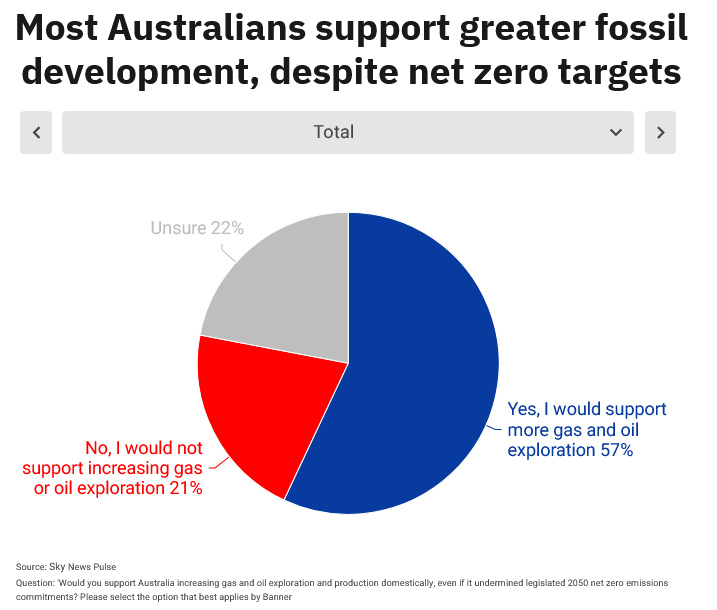
It is interesting what polling in Australia is finding on the public's attitude to wind and solar as opposed to fossil fuels.

poll-sky-news-oil-gas.jpg


Then there is another interesting recent national poll of Australian voters by the respected British polling firm YouGov. It found that a small party that received 3% of the vote in last year's parliamentary election focusing on other issues, but has since come out strongly opposed to wind and solar is now tied with the country's current governing (pro-wind and solar) party for first place, both with 28%. The small party jumping into the wind/solar issue had led a coalition of two parties, one that runs in rural areas and one in urban, that is now the main opposition, to revise their policies, the rural party also now taking a strong position opposed to wind and solar and the urban party coming out opposing it in all places where the local people do not want it. That coalition was third in the poll at 21%. That former 3% party also just scored over 20% in the state election in South Australia, a longtime stronghold of the governing party, coming in second there. Those numbers reflect an embrace by Australians of opposition to wind and solar.
 
The elections will be the final arbiter of energy policies
Polls are an unreliable measure

Remember the predictions about Orban in Hungary
He was going to win in a landslide by some polls

The electorate and final vote gave different results
 
Last edited:
The cost overruns on Vogtle 3 and 4 skewed the LCOE on nuclear power

The projections are for lower costs of construction per MWH for Gen IV Nuclear Power Plants

This will make the LCOE on Nuclear more competitive
 
The elections will be the final arbiter of energy policies
Polls are an unreliable measure

Remember the predictions about Orban in Hungary
He was going to win in a landslide by some polls

The electorate and final vote gave different results

That is why I mentioned the very recent state election in the state of South Australia. It was totally in sync with what the polling said about that party that had been a 3% party. The most recent national poll was from a very reputable polling firm with an international reputation.

I can contrast that with polls in eastern Europe. Where I worked local polling companies were well known to pad political polls if parties paid them. When I needed a poll I hired an internationally known company to come in and conduct it in order to get accurate information.

Oh, and the election earlier this month in Bulgaria brought to power a brand new party that campaigned against the EU climate agenda and won a landslide.
 
Last edited:
And physics ultimately decideds the energy "vote"


View attachment 124785


.

Hardly an objective source. "The Decarbonbization Channel" clearly has an agenda here, as do some of your other sources which have included a "World Socialist" website and an investment bank that services wind and solar operators.

The key is that the Climate Industrial Complex fails to account for the system costs, you know the thing that makes wind and solar more expensive than conventional energy by the time it hits your meterbox.
 
Hardly an objective source. "The Decarbonbization Channel" clearly has an agenda here, as do some of your other sources which have included a "World Socialist" website and an investment bank that services wind and solar operators.

The key is that the Climate Industrial Complex fails to account for the system costs, you know the thing that makes wind and solar more expensive than conventional energy by the time it hits your meterbox.
What "system" costs
You mean the cost for the wires to move the electricity from point A to point B

Please explain in detail what YOU mean by system costs
 
That is why I mentioned the very recent state election in the state of South Australia. It was totally in sync with what the polling said about that party that had been a 3% party. The most recent national poll was from a very reputable polling firm with an international reputation.

I can contrast that with polls in eastern Europe. Where I worked local polling companies were well known to pad political polls if parties paid them. When I needed a poll I hired an internationally known company to come in and conduct it in order to get accurate information.

Oh, and the election earlier this month in Bulgaria brought to power a brand new party that campaigned against the EU climate agenda and won a landslide.
Bulgaria seems to be in a constat state of flux
8 elections in 5 years

They seem to be pretty poor in comparison to other EU Countries

Bulgaria has the lowest standard of living in the EU by the main comparable metric — GDP per capita adjusted for purchasing power (PPS).

In 2025, Bulgaria and Greece were tied for last place at 68% of the EU average, meaning Bulgarians have about two‑thirds of the purchasing power of the average EU resident.

But they have lots of mercury in their water to compensate
 
That is why I mentioned the very recent state election in the state of South Australia. It was totally in sync with what the polling said about that party that had been a 3% party. The most recent national poll was from a very reputable polling firm with an international reputation.

I can contrast that with polls in eastern Europe. Where I worked local polling companies were well known to pad political polls if parties paid them. When I needed a poll I hired an internationally known company to come in and conduct it in order to get accurate information.

Oh, and the election earlier this month in Bulgaria brought to power a brand new party that campaigned against the EU climate agenda and won a landslide.
Regarding South Australia Election

The election returned the Malinauskas Labor government with an increased majority, meaning the same party and Premier continue to govern.There was no leadership change at the top.

Labor’s platform is described as building on South Australia’s “strong shift towards renewable energy,” with a formal goal of 100% net renewables by 2027. Their plan includes:

  • Expanding large‑scale wind and solar
  • Supporting big batteries and long‑duration storage
  • Keeping some gas capacity for reliability during the transition
  • Streamlining approvals for renewable projects
Summary: Labor is strongly pro‑renewables and frames the transition as both economic and technical policy.

Does not appear that the renewable crowd lost their majority
 
.What "system" costs
You mean the cost for the wires to move the electricity from point A to point B

Please explain in detail what YOU mean by system costs
Oh, come on. I have posted quite a few articles where experts explain this problem. Much of it has to do with the cost of backup, and the feast and famine nature of wind and solar. The German Minister of Economy and Energy understands this even if you pretend not to.
 
Bulgaria seems to be in a constat state of flux
8 elections in 5 years

They seem to be pretty poor in comparison to other EU Countries

Bulgaria has the lowest standard of living in the EU by the main comparable metric — GDP per capita adjusted for purchasing power (PPS).

In 2025, Bulgaria and Greece were tied for last place at 68% of the EU average, meaning Bulgarians have about two‑thirds of the purchasing power of the average EU resident.

But they have lots of mercury in their water to compensate

Yes, they have been rather unstable for years, which is what makes the election this month so significant with one party winning a landslide for a clear majority without having to build a coalition. The new government ran AGAINST the EU climate agenda and has also been critical of the outgoing coalition's recent adoption of the euro. The new prime minister had demanded a referendum of citizens on the euro, and polls showed they oppose that adoption.

The new Czech prime minster was even more strident during his campaign earlier this year against the EU climate agenda which he described repeatedly as "green madness."
 
Last edited:
Top