• Welcome to the FREE TUGBBS forums! The absolute best place for owners to get help and advice about their timeshares for more than 32 years!

    Join Tens of Thousands of other owners just like you here to get any and all Timeshare questions answered 24 hours a day!
  • TUG started 32 years ago in October 1993 as a group of regular Timeshare owners just like you!

    Read about our 32nd anniversary: Happy 32nd Birthday TUG!
  • TUG has a YouTube Channel to produce weekly short informative videos on popular Timeshare topics!

    All subscribers auto-entered to win all free TUG membership giveaways!

    Visit TUG on Youtube!
  • TUG has now saved timeshare owners more than $24,000,000 dollars just by finding us in time to rescind a new Timeshare purchase! A truly incredible milestone!

    Read more here: TUG saves owners more than $24 Million dollars
  • Wish you could meet up with other TUG members? Well look no further as this annual event has been going on for years in Orlando! How to Attend the TUG January Get-Together!
  • Now through the end of the year you can join or renew your TUG membership at the lowest price ever offered! Learn More!
  • Sign up to get the TUG Newsletter for free!

    Tens of thousands of subscribing owners! A weekly recap of the best Timeshare resort reviews and the most popular topics discussed by owners!
  • Our official "end my sales presentation early" T-shirts are available again! Also come with the option for a free membership extension with purchase to offset the cost!

    All T-shirt options here!
  • A few of the most common links here on the forums for newbies and guests!

The airborne lifetime of small speech droplets and their potential importance in SARS-CoV-2 transmission

Ken555

TUG Review Crew: Veteran
TUG Member
Joined
Jun 7, 2005
Messages
15,237
Reaction score
6,350
Location
Los Angeles
Resorts Owned
Westin Kierland
Sheraton Desert Oasis
The airborne lifetime of small speech droplets and their potential importance in SARS-CoV-2 transmission


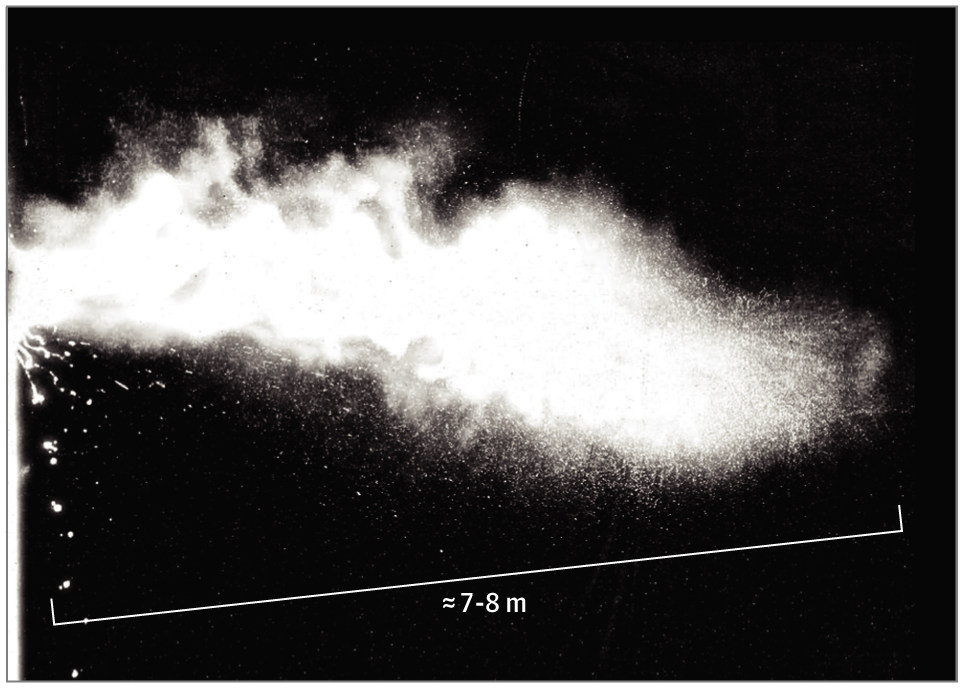
Speech droplets generated by asymptomatic carriers of severe acute respiratory syndrome coronavirus 2 (SARS-CoV-2) are increasingly considered to be a likely mode of disease transmission. Highly sensitive laser light scattering observations have revealed that loud speech can emit thousands of oral fluid droplets per second. In a closed, stagnant air environment, they disappear from the window of view with time constants in the range of 8 to 14 min, which corresponds to droplet nuclei of ca. 4 μm diameter, or 12- to 21-μm droplets prior to dehydration. These observations confirm that there is a substantial probability that normal speaking causes airborne virus transmission in confined environments.
 
What I find interesting and re-assuring is that 12 to 21 um (or micron) droplets are pretty big and an N95 mask/respirator does a pretty good job of catching them. In fact, even when they dehydrate to 4 microns, it is still in the range of an N95 mask.

I've read that the size of the covid particle (without the water carrier) is around 0.15 to 0.2 microns and that the N95 mask won't catch them. So, when I read that 4 micron droplets fall out of the air, that is (in my opinion) re-assuring.
 
BTW, @Ken555 , thanks for posting.
 
What I find interesting and re-assuring is that 12 to 21 um (or micron) droplets are pretty big and an N95 mask/respirator does a pretty good job of catching them. In fact, even when they dehydrate to 4 microns, it is still in the range of an N95 mask.

I've read that the size of the covid particle (without the water carrier) is around 0.15 to 0.2 microns and that the N95 mask won't catch them. So, when I read that 4 micron droplets fall out of the air, that is (in my opinion) re-assuring.

Yes, I was wondering if anyone was going to highlight that. Early on we were discussing the effectiveness of masks, and microdroplets (see that early video on how long microdroplets stay in air without ventilation..l think it was three hours), etc. I have HEPA air purifiers at home and in March was uncertain if they would catch COVID or not, but it’s looking now like they actually might (I haven’t read much about this...), though it wouldn’t be 100% effective.


Sent from my iPad using Tapatalk
 
Yes, I was wondering if anyone was going to highlight that. Early on we were discussing the effectiveness of masks, and microdroplets (see that early video on how long microdroplets stay in air without ventilation..l think it was three hours), etc. I have HEPA air purifiers at home and in March was uncertain if they would catch COVID or not, but it’s looking now like they actually might (I haven’t read much about this...), though it wouldn’t be 100% effective.


Sent from my iPad using Tapatalk
If someone with COVID19 is in your house with you for any period of time, I expect you have a very high chance of catching it.
 
This explains why family transmission is high. Perhaps this would also explain why so many vulnerable in NY who were SIP in-home transmissions. Perhaps they were exposed to a family member who went out regularly.
 
We've got the studies showing droplets/sizes hang in the air. Now we need studies on regular breathing and how long/much you would need for an infection to take hold. And whether effects of sunlight/breeze make a decreased chance of infection - like at a beach. And whether homemade cloth masks catch those teeny droplets. I cover my mouth when I sneeze/cough anyway (solid barrier of hands or crook of elbow and GROSS sneezing into a mask-yuck).
 
If someone with COVID19 is in your house with you for any period of time, I expect you have a very high chance of catching it.

Yes, we knew that in March.


Sent from my iPad using Tapatalk
 
And whether homemade cloth masks catch those teeny droplets.

They do not. There was a report we posted here in March about the comparable benefits of different types of masks. The issue about masks is not to catch the virus but to prevent them from spreading far from you when you exhale or cough, etc. Without any mask they can travel quite far. It’s not perfect, but there’s still every reason to wear one. On a related note, it was announced last night that in Los Angeles we are now required to wear masks whenever outside the home (I believe before now it was recommended everywhere and only required inside businesses; now it is required everywhere).


Sent from my iPad using Tapatalk
 
If someone with COVID19 is in your house with you for any period of time, I expect you have a very high chance of catching it.
And not just from breathing in suspended droplets. Those droplets will eventually fall on surfaces in the home where they can easily be transferred to one's hands, which then touch one's face ...
 
If someone with COVID19 is in your house with you for any period of time, I expect you have a very high chance of catching it.
My friend had Covid-19, with a very bad case (7 days in the hospital O2 level 75%). All his family members (4) got a very very mild case of covid-19. So in their case 100% got it from a family member.
 
This is a relevant document for this topic.

Turbulent Gas Clouds and Respiratory Pathogen Emissions
Potential Implications for Reducing Transmission of COVID-19


Sent from my iPad using Tapatalk
 
The issue about masks is not to catch the virus but to prevent them from spreading far from you when you exhale or cough, etc.
That's what I mean. If it's not catching going in, why do we expect that it's better on exhalation (which is usually forceful obviously than breathing in) and catching the teeny droplets going out?? Sure catches the "big" droplets-that fall to ground faster anyway.

Seems like it's taboo to question the usefulness of masks at all ;) :) But it would be helpful to really know what is the most effective-like does chiffon layered with cotton make it easy to breathe while being an effective "catcher's mitt"? One study I saw showed you'd need 17 layers of cotton to be effective at both catching and filtering:oops:. And that loose bandannas did nothing to catch or filter.
 
That's what I mean. If it's not catching going in, why do we expect that it's better on exhalation (which is usually forceful obviously than breathing in) and catching the teeny droplets going out?? Sure catches the "big" droplets-that fall to ground faster anyway.

Seems like it's taboo to question the usefulness of masks at all ;) :) But it would be helpful to really know what is the most effective-like does chiffon layered with cotton make it easy to breathe while being an effective "catcher's mitt"? One study I saw showed you'd need 17 layers of cotton to be effective at both catching and filtering:oops:. And that loose bandannas did nothing to catch or filter.

Read the reports again. From what I read the masks, even cloth masks, stop the velocity of the exhalation so that the droplets don’t go as far. That’s the reason for a mask. It’s not to protect you, it’s to protect others.

We should absolutely question the veracity of masks, as we are doing here. When better solutions, or material, is produced (as I’m sure it will be...I’ve already been watching a few early options that look better) I’m sure we will want to switch to them, since I suspect the next round of mask innovation will be to protect the wearer.


Sent from my iPad using Tapatalk
 
Do you know why 6 feet was chosen as the recommended space to distance?

Good question.

That metric — 6 feet — is pulled from guidance designed by the Centers for Disease Control and Prevention for medical providers to prevent the spread of infectious respiratory diseases between themselves and their patients in a health care setting. It’s based on past studies of infection among health care workers, and specific to illnesses like the flu that are transmitted by respiratory droplets released when an infected person coughs, sneezes or even talks. Like the flu, novel coronavirus is believed to be transmitted primarily via those droplets.

Keep in mind six feet is just guidance. It's likely that we should actually be much further apart, but I'm not sure how practical that would be in many circumstances. If you want to minimize the risk, stay as far away as possible, not just the recommended distance.
 
it is interesting to note that the study states it measured the air movement equivalent to a loud voice, 85dB. The problem is 85 dB is not the normal level of the human voice, it is the sound level of a chainsaw. I would like to know if the study also covered normal talk of regular folks not just the Luciano Pavarottis of the world.
 
it is interesting to note that the study states it measured the air movement equivalent to a loud voice, 85dB. The problem is 85 dB is not the normal level of the human voice, it is the sound level of a chainsaw. I would like to know if the study also covered normal talk of regular folks not just the Luciano Pavarottis of the world.

No, that's not what it says. Let's be accurate. It says in a caption:

Light scattering observation of airborne speech droplet nuclei, generated by a 25-s burst of repeatedly speaking the phrase “stay healthy” in a loud voice (maximum 85 dBB at a distance of 30 cm; average 59 dBB).
 
No, that's not what it says. Let's be accurate. It says in a caption:
the problem is if you average 35 and 85 you will get 60 but all you will measure in terms of droplets is the ones from 85. You are not measuring the normal voice at 60. Let's be smart
 
the problem is if you average 35 and 85 you will get 60 but all you will measure in terms of droplets is the ones from 85. You are not measuring the normal voice at 60. Let's be smart

I don’t know how else to put it. The average was 59. If you think a regular conversation has no change...well, I’m moving on.


Sent from my iPad using Tapatalk
 
I don’t know how else to put it. The average was 59. If you think a regular conversation has no change...well, I’m moving on.


Sent from my iPad using Tapatalk
if you measure the impact of two cars running at 60km/h into a wall vs one at 35km/h, another one at 85 km/h you will get very different results. If the person suffering the impact at 85km/h dies, it does not mean that the ones running at 60km/h will die as well, let alone the one running at 35 km/h
I thought it was rather obvious they should present the detailed results, not the "average" because they are not measuring the average but rather the peak.
 
Last edited:
:wall:


Sent from my iPad using Tapatalk
 
If masks don't protect the wearer against others, why do health care workers wear them? There are varying degrees of protection, depending on type of masks. Because our government is afraid of people hoarding N95 and 3-ply surgical masks, it is asking everyone else to wear cloth masks. Cloth masks are low on efficacy in protecting the wearers. Unlike N95 masks, 3-ply masks are available for purchase by the public.

We had another Telehealth session with our PCP this week and he told us to go for our 6-month lab tests and to see him in person. When we go to our lab appointment, we plan to wear both the 3-ply surgical mask and cloth sports mask which includes a 5-layer disposable filter, with the surgical mask on the inside. We tried it at home and did not have difficulty breathing through the 2 masks. We will probably do the same when we visit our PCP. We really don't want to get sick.
 
If masks don't protect the wearer against others, why do health care workers wear them?
First-would you be surprised to learn that there are few studies showing masks are effective? And the ones that are have pretty specific requirements in fit and material 2nd-masks are one part of PPE-which includes air filtration, gloves, face shields, gowns, UV lights, hand sanitation etc. It is something that is "always" done without alot of evidence to back it up - although it IS one of those things that isn't going to cause harm. One thing to come out of this is better understanding what masks can and can't do, and best composition of material for masks; long overdue.
Just like it was "understood" fat 'causes' heart disease, and margarine was better than butter-until actual studies came out saying-"no wait"...
 
....It is something that is "always" done without alot of evidence to back it up

I'm not sure that's true. In countries with superior PPE for doctors, they didn't lose them to COVID19. We did.
 
Top